
Criminal Court Records in Monroe County
A criminal court record is the case file the court clerk opens the moment a charge is filed against a defendant. It grows as the case moves, gathering the charging document, court orders, hearing dates, the plea, the disposition, and the sentence. In Monroe County the Circuit Clerk keeps the records for felony prosecutions heard in Circuit Court. The clerk maintains a general court docket with names, parties, pleas, indictments, lower-court appeal records, and related papers. Each entry is tied to a case number, and a criminal file stays with the court long after the case closes.
Several courts produce criminal records in the county. The Circuit Court hears felony prosecutions and jury trials, and it also hears criminal appeals from Justice Court and from every municipal court in Monroe County. Justice Court in Amory handles misdemeanors, traffic offenses outside city limits, bond hearings, and preliminary felony hearings. Municipal courts in Aberdeen, Amory, and Smithville handle city misdemeanors and ordinance cases. The charges themselves are covered in more depth on the Monroe County arrest records and court charges page.
How to Search Monroe County Criminal Court Records
Circuit Court criminal cases flow through Mississippi Electronic Courts, the statewide system known as MEC and its public counterpart PAMEC. Monroe County Circuit Court went live on MEC on May 23, 2022, and the First Circuit District uses the site first.circuit.mec.ms.gov. The public login requires credentials, so full case detail is not openly browsable without an account.
- Open the First Circuit MEC site and sign in, or register for public access at the PAMEC online registration page.
- Search by defendant name or by case number once you are logged in.
- Narrow the results by court, case type, and filing date to find the matter.
- Open the case to read the docket entries, the disposition, and the sentence.
- Request a certified copy from the Circuit Clerk when you need an official document.
Older or non-digitized files are not always online. For those, contact the First Circuit Court clerk in Aberdeen and ask for a record search or copies under the published fee schedule. The clerk charges $12.00 per hour for record searches, $1.00 per page for clerk-made copies, and $1.00 per document for certified copies.
Stages of a Criminal Case in Monroe County
A felony case in Monroe County moves through a set order, and each step leaves its own mark in the record. The grand jury convenes three times a year and returns indictments. Circuit Court criminal terms then sit in February, June, and October, when arraignments, pleas, and trials are scheduled. Reading a file in order shows exactly where a case stands.
Case flow: Charges Filed › Arraignment › Pretrial / Motions › Plea or Trial › Disposition › Sentencing
| Stage | What Happens |
|---|---|
| Arraignment | Charges are read, the defendant enters a plea, and the court addresses counsel and the next appearance date. |
| Pretrial / Motions | Written motions, bond matters, and continuances are filed and ruled on before trial. |
| Plea or Trial | The case resolves by guilty plea or negotiated plea, or it proceeds to a jury trial for a verdict. |
| Sentencing | After a conviction the judge orders punishment, which may include jail, probation, fines, or restitution. |
Note: At arraignment defendants are told when to appear, and a missed date means they must appear on the first day of the term or risk a bench warrant.
Prosecutors and Defense in Monroe County Criminal Cases
Two different prosecuting offices appear in Monroe County criminal files. The District Attorney for the First Circuit Court District prosecutes felonies in Circuit Court. Jason D. Herring serves as District Attorney, and Assistant District Attorneys Paul Gault and Nebra Porter are assigned to handle Monroe County cases through the District Attorney's Tupelo office on West Franklin Street. The Monroe County Attorney handles a separate set of duties.
The Governor's office announced Herring's appointment in a public release covering the seven counties of the First Circuit District. The First Circuit District Attorney appointment release sets out the district's reach.
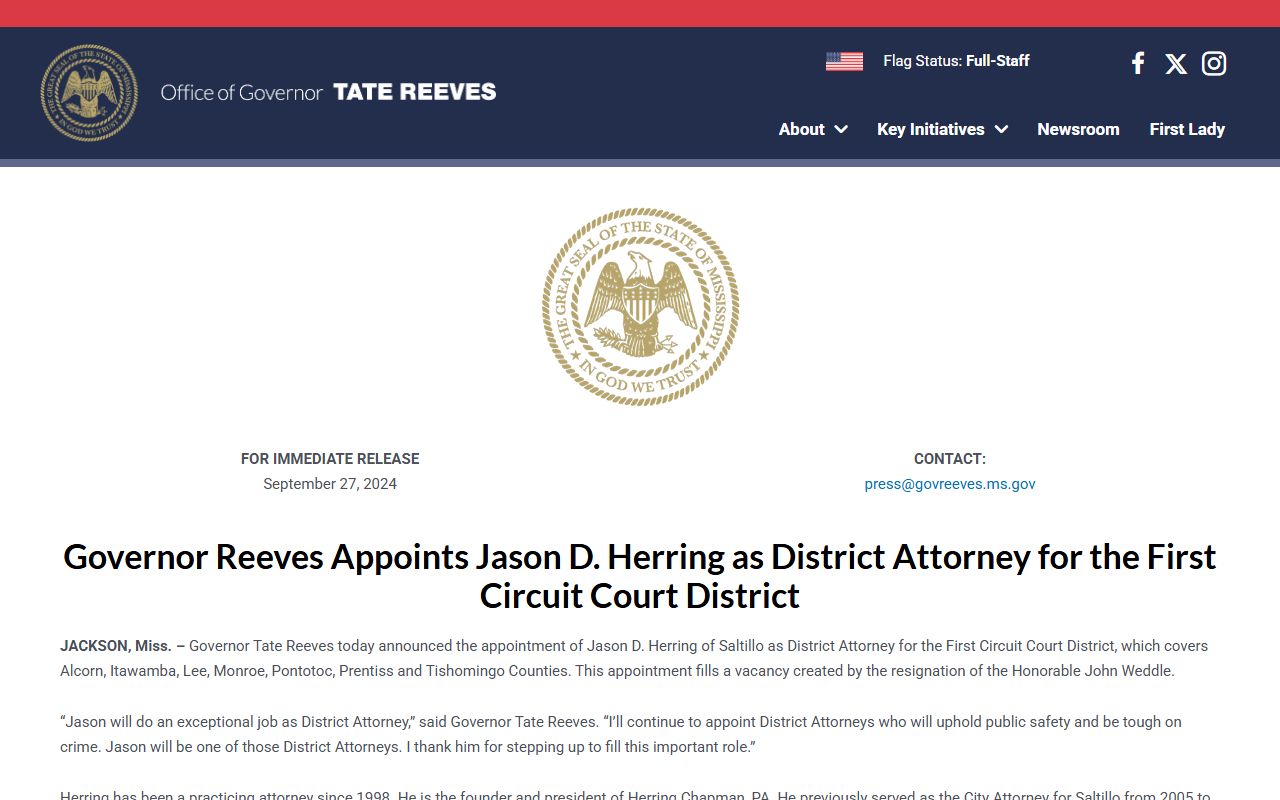
That release confirms which prosecutor's name belongs on a Monroe County felony file. The County Attorney, by contrast, appears for the state in felony investigations before Justice Court judges, prosecutes misdemeanors there, and serves as Youth Court prosecutor.
Candace Cooper Blalock holds the County Attorney role and works from West Commerce Street in Aberdeen. Her office also represents the state when a criminal case is appealed from Justice Court to Circuit Court. The Monroe County Attorney page describes these prosecuting duties in detail.
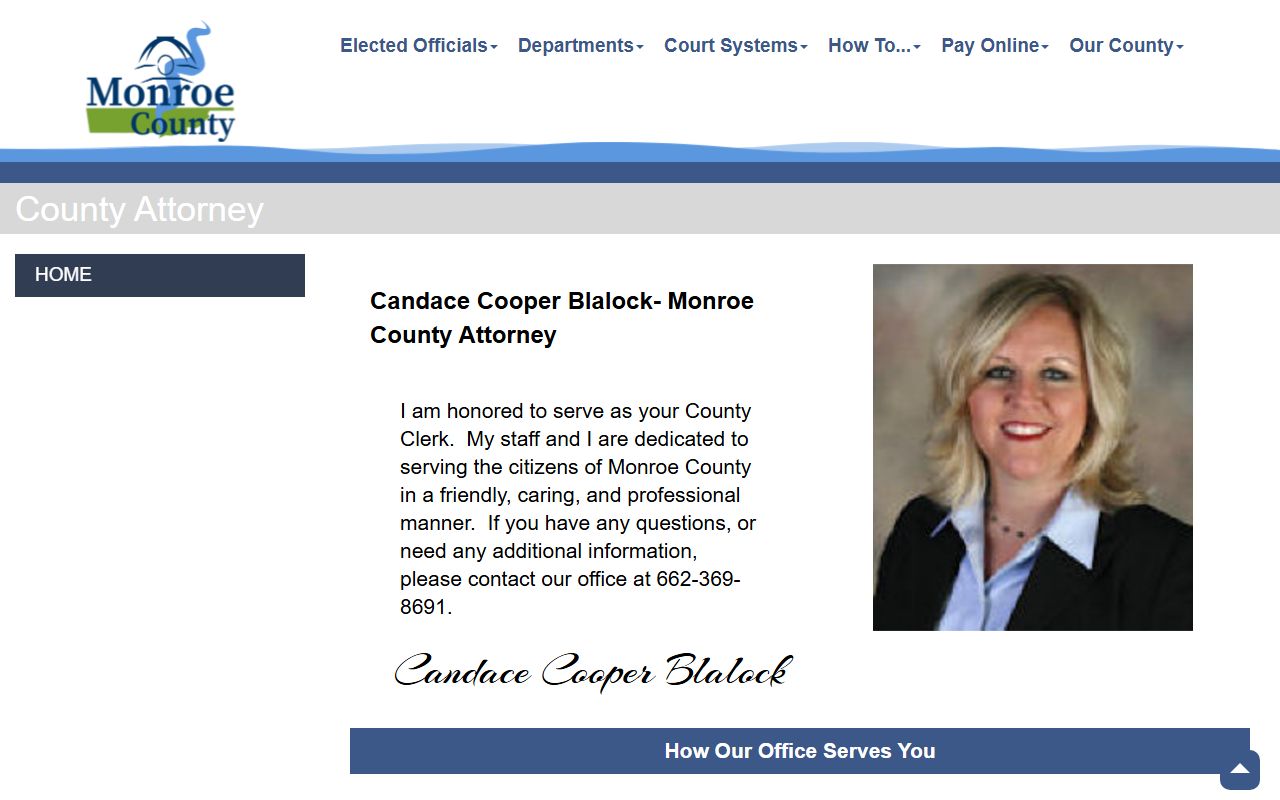
The page makes clear that the County Attorney and the District Attorney are not the same office. On the defense side, the Circuit Court lists public defenders Christopher Bauer and Luanne Thompson. The court warns that defendants must contact their own attorney and know when to appear, since a missed term date can lead to arrest.
What a Monroe County Criminal Court Record Shows
A Circuit Court criminal file holds a predictable set of fields. The index data names the defendant and the case, while the docket tracks every filing and order in date sequence. The fields below appear on most felony case files kept by the Circuit Clerk.
| Field | What It Shows |
|---|---|
| Case Number | The court's unique case identifier, often followed by judge initials such as PFM, KMM, JWM, or MMM. |
| Defendant | The person charged, listed by name and tied to the case. |
| Charges | The indictment or charging document and the specific offense or offenses alleged. |
| Plea | The defendant's formal answer, such as guilty or not guilty, entered at arraignment. |
| Disposition | The case outcome, such as a guilty plea, dismissal, conviction, or acquittal. |
| Sentence | The punishment ordered after a conviction, including jail, probation, fines, or restitution. |
Docket entries, bond papers, motions, court orders, and fine or restitution payment accounts also sit in the file. Public copies often redact Social Security numbers, financial account numbers, and information about minors. A full set of every court record type, civil and criminal, lives on the Monroe County court records page.
Reading Dispositions and Sentences
The disposition is the single most important line in a criminal file because it reports how the case ended. A disposition can read as a guilty plea, a conviction at trial, an acquittal, a dismissal, or a no-contest plea. The sentence follows a conviction and spells out the punishment. Knowing a few core terms makes the record far easier to read.
- Disposition
- The case outcome, such as a guilty plea, dismissal, conviction, or acquittal.
- Sentence
- The punishment ordered after a conviction, which may combine jail, probation, fines, and restitution.
- Probation
- Court-ordered supervision served instead of, or after, time in custody.
- Restitution
- Money the court orders a defendant to repay a victim.
- Continuance
- A rescheduling of a hearing or trial to a later date.
Payment accounts attach to many sentences. Criminal fines, fees, and restitution can be paid online at mycircuitcourtpayment.com or by phone at 1-800-393-0180, and the Circuit Clerk does not accept personal checks.
Charges vs. Convictions
Being charged is not the same as being convicted. A criminal court record can show charges that were later dropped, dismissed, reduced, or that ended in an acquittal. A charge is only an accusation, and the file should be read to its disposition before any conclusion is drawn about guilt.
| Charge | Conviction | |
|---|---|---|
| Stage | Accusation | Verdict or plea |
| Burden of Proof | Probable cause | Beyond reasonable doubt |
| Who Decides | Grand jury or prosecutor | Judge or jury |
| Public Record | Yes | Yes |
A grand jury indictment opens a felony charge, but only a guilty plea or a verdict creates a conviction. The same file may list several charges with different outcomes, so each count needs its own reading.
Public Access to Monroe County Criminal Court Records
Mississippi treats court records as public unless another law makes them confidential. The Public Records Act supports access to nonexempt government records, while separate statutes shield juvenile, sealed, and certain law-enforcement materials. The practical starting point is the office that holds the record, which for felony files is the Circuit Clerk.
Key Statutes:
Miss. Code Ann. § 25-61-1 through 25-61-19 - the Mississippi Public Records Act makes government records available unless a law exempts them.
Miss. Code Ann. § 25-61-12 - incident reports are public, while investigative reports and certain victim details are exempt or restricted.
Miss. Code Ann. § 99-19-71 - eligible dismissals, acquittals, and some convictions may be expunged by petition.
Fees and timing depend on the custodian, the format, and any redaction needed. A public body may charge actual costs for search, copying, and mailing, and may ask for payment in advance.
Sealed vs. Expunged Criminal Records
Two outcomes can pull a criminal record out of ordinary public view, and they are not the same. A sealed record still exists but is hidden from routine inspection. An expunged record is treated as though it never existed. Expungement in Mississippi runs under Section 99-19-71 and requires a petition in the court where the charge originated.
| Sealed | Expunged | |
|---|---|---|
| Visibility | Hidden from public | Treated as never existed |
| Law Enforcement | Limited access | Very limited access |
| Eligibility | Set by court order and statute | Eligible dismissals, acquittals, and some convictions |
To expunge a Monroe County case, a person first identifies the court of conviction or charge, then gathers stamped documents showing the charge, disposition, sentence, and a zero balance. The Circuit Clerk lists an expungement petition fee of $150.00, and all court costs and fines must be paid first. General steps appear in Mississippi expungement process guidance published for the region.

That guidance outlines the petition and the prosecutor-notice steps that follow. Once a judge grants the order, agencies should remove the eligible record from ordinary public access.
Restricted Criminal Court Records in Monroe County
Some criminal matters never reach the public docket at all. Youth Court records are confidential except as allowed by Mississippi juvenile law, and the public should not expect a downloadable file for those cases. Sealed indictments, active investigations, and juvenile warrants are also kept out of routine searches.
- Youth Court delinquency and abuse or neglect files, confidential under state juvenile law.
- Sealed and expunged cases removed from ordinary public access by court order.
- Investigative law-enforcement reports and certain victim-identifying details.
- Sealed indictments and active investigations not yet made public.
When a record is restricted, the clerk or court must confirm whether any nonconfidential portion can be released. For booking and custody status rather than the court file, the jail roster on the inmate records page is the better starting point.